Turning Training into Readiness
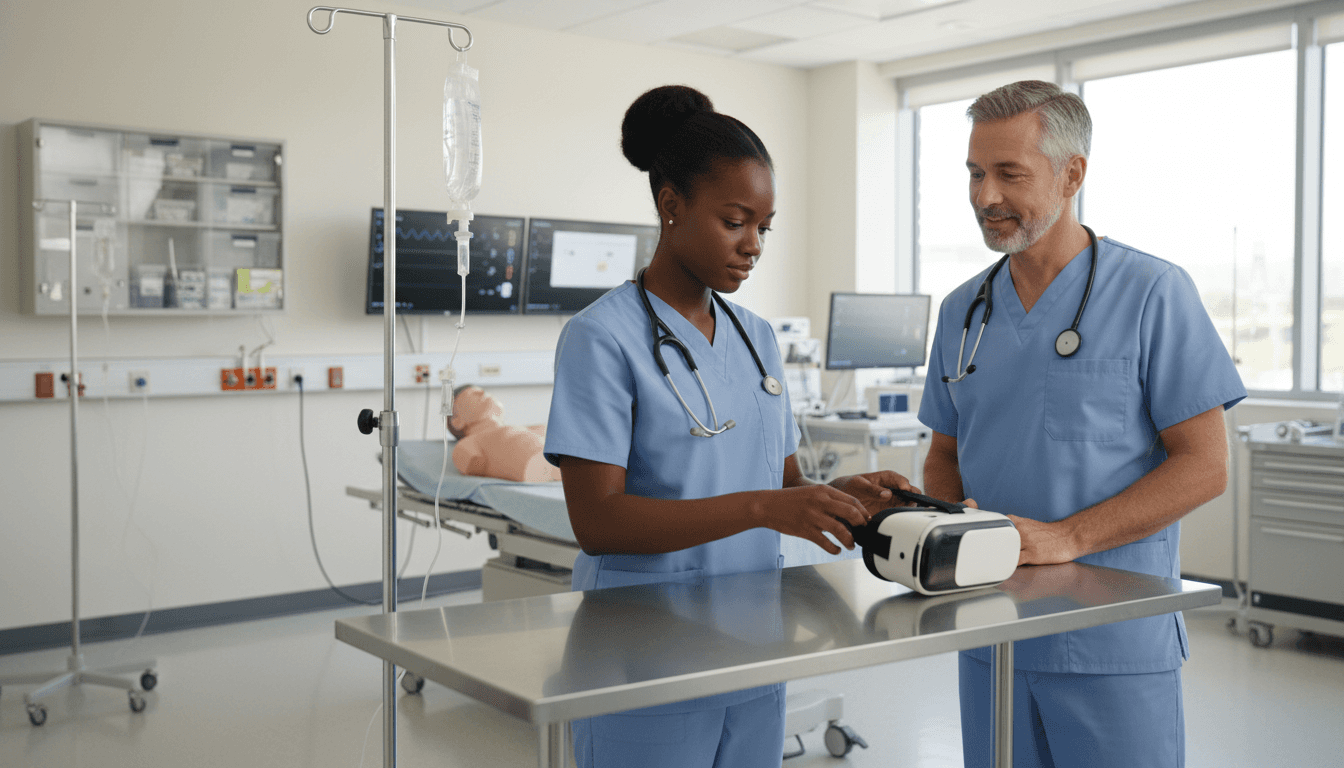
From Reset to Readiness: How AI + VR Reduce Faculty & Simulation Labor While Improving Learning
How a North American-based nursing program used AI-enabled VR simulation to reduce setup burden, standardize feedback, and expand high-quality practice, without increasing faculty headcount.
Case Study Overview
Challenge & Context
Simulation is a proven bridge between classroom learning and clinical readiness, but it’s also resource intensive. High-fidelity simulation often requires substantial setup, troubleshooting, and operator expertise, and many programs report constraints tied to staffing, time, and throughout (NIH).
At the same time, nursing education is operating inside a capacity bottleneck: in the U.S., schools continue to report tens of thousands of qualified applications turned away due to limitations including faculty and clinical placement capacity (AACN).
Bottom line: Programs need learning experiences that scale, without scaling labor at the same rate.
Approach & Solution Framework
A regional nursing program partnered with Patient Ready to complement existing simulation with AI-enabled VR scenarios designed to:
Reduce repetitive faculty tasks (re-orientation, repeated baseline coaching, re-running the same scripted role plays).
Reduce sim staff setup/reset workload by shifting selected learning objectives into reusable VR modules.
Improve learning through standardized scenarios, repeatable practice, and data-supported debriefing aligned with simulation best practices (ELSEVIER).
Measurable Results & Impact (Directional Outcomes)
Within two terms, the program reported outcomes consistent with published evidence about simulation workload constraints and the effectiveness of VR learning:
Lower setup and troubleshooting burden for selected scenario types by shifting them into VR modules that require less physical room turnover than many traditional setups (directional; program-reported). This aligns with literature describing high-fidelity simulation as time-consuming to set up and difficult to staff (NIH).
More consistent baseline feedback via AI-supported summaries/transcripts, allowing faculty to spend more debrief time on higher-order coaching (clinical judgment patterns, communication nuance) rather than repeating foundational reminders (NIH).
Expanded access to high-quality reps (more learners completing more practice cycles) without proportionally increasing SP days or lab schedule complexity (directional; program-reported).
Improved learning indicators aligned to published research showing VR simulation can improve learning outcomes (including communication and knowledge measures) and may be cost-effective versus some traditional approaches (NIH).
Key Insights
Simulation labor is a design variable. When the right objectives move into VR modules, faculty and sim teams can reclaim time for what humans do best: contextual coaching, reflective debriefing, and learner support (INACSL).
Standardization improves fairness and speed. Consistent scenario delivery reduces variability across sections and instructors, especially important in large cohorts.
AI doesn’t replace debriefing. It strengthens it. AI-supported artifacts (transcripts, pattern flags) can reduce cognitive load and support more structured debriefing aligned with best practice (INACSL).
1. Background & Context: Why Simulation Time is the New Scarcity
Healthcare simulation is widely used because it builds competence in a safe setting. However, traditional approaches, especially high-fidelity and SP-based events, can be costly and faculty-time intensive, limiting how often learners can practice (NIH).
Recent qualitative evidence from nursing faculty highlights operational friction points:
Setup and operation can be time-consuming and exhausting.
Lack of trained operators forces faculty to “figure it out,” increasing workload.
Large class sizes plus limited time reduce how broadly simulation resources can be used (NIH).
Meanwhile, accreditation and workforce pressures push programs to produce more practice-ready graduates without expanding faculty headcount at the same rate (AACN).
2. The Challenge: High Learning Demand, High Setup Burden
The nursing program in this case study (de-identified) had:
A strong simulation foundation (skills lab + selected high-fidelity events).
Growing enrollment pressure and constrained scheduling windows.
A small simulation operations team responsible for room turnover, equipment readiness, and supporting multiple courses.
Pain points surfaced in internal review:
High reset frequency: repeated physical room setup and cleanup across sections.
Inconsistent baseline coaching: different instructors emphasized different “must-hit” items; learners received uneven early feedback.
Limited reps: some objectives (communication, escalation recognition, prioritization) were practiced once (if at all) because scaling SP events and lab time is difficult (NIH).
Guiding question:
How can we reduce “simulation labor per learner rep” while improving learning quality?
3. Objectives
The program and Patient Ready defined objectives designed to be template-ready for similar partners:
Reduce faculty time spent on repetitive baseline feedback by introducing AI-supported feedback artifacts (transcripts/summaries) that standardize first-pass coaching (sciencedirect).
Reduce sim staff setup/reset burden for selected scenario types by shifting appropriate objectives into VR modules (directional).
Increase learner reps per term for targeted competencies without expanding SP days or adding lab hours (directional).
Strengthen debrief quality by using structured, evidence-aligned debriefing supported by AI artifacts and consistent scenario flow (INACSL).
Demonstrate operational value via measurable process metrics (setup time, session throughput, faculty minutes per learner, scheduling flexibility).
4. Approach: AI-Enabled VR as a “Labor-Leverage Layer”
Patient Ready’s approach was framed as additive, not replacement: keep high-fidelity experiences where they are uniquely valuable, and use VR + AI where repetition, standardization, and data capture create leverage.
4.1 Scenario Selection: Match Modality to Objective
The team prioritized objectives that tend to be high-frequency and repeatable, such as:
Recognizing deterioration cues and escalation triggers
Communication under time pressure (handoffs, family updates, de-escalation)
Prioritization and sequencing decisions
These are areas where repeated practice matters, and where standardization reduces variability across learners.
4.2 Technology & Learning Model
The deployment included:
Immersive VR scenarios aligned to course outcomes
AI-supported learner artifacts (e.g., transcripts, structured summaries, feedback prompts) to reduce cognitive load for facilitators and improve debrief focus (sciencedirect).
Repeatability by design: learners can re-run scenarios to close gaps without creating new scheduling burden (directional).
This aligns with broader findings that virtual/VR simulation can support learning benefits and can be an efficient, scalable platform for complex situations (NIH).
4.3 Debriefing Workflow (Best-Practice Aligned)
Each session followed a consistent structure aligned with simulation standards emphasizing planned debriefing processes:
Prebrief (5-10 min): expectations, psychological safety, objectives
VR scenario (10-20 min): individual rotations
AI-supported artifact review (3-5 min): key moments, patterns, gaps
Faculty-led debrief (10-20 min): meaning-making and transfer to practice
5. Implementation: A Phased, Low-Friction Rollout
Phase 1: Pilot in One High-Volume Course
Limited initial scope (3-4 scenarios) to avoid overwhelming faculty.
Used existing rubrics to avoid adding new assessment overhead.
Collected structured feedback from faculty + sim staff on workflow and time burden.
Phase 2: Operational Integration
Standardized headset logistics, room flow, and “quick start” checklists.
Built a repeatable staffing model so sim staff weren’t reinventing processes weekly.
Established a simple tracking approach (minutes spent on setup, resets, troubleshooting).
Phase 3: Scale to Additional Courses
Expanded scenario library aligned to curricular needs.
Reduced orientation time as learner familiarity increased, freeing more time for substantive debrief (directional).
6. Results: Less Reset, More Reps, Better Debriefs (Directional Outcomes)
6.1 Faculty Time: From Repetition to Coaching
Faculty reported spending less time repeating foundational corrections (e.g., “say it this way,” “don’t miss this step”) and more time on:
clinical reasoning patterns
communication nuance
transfer-to-practice reflection
This direction aligns with research on AI-supported instruction demonstrating that well-designed AI feedback can reduce reliance on scarce expert time in skills training contexts (NIH).
6.2 Simulation Operations: Reduced Setup/Reset Burden for Selected Objectives
Simulation staff reported that for the objectives moved into VR modules, sessions required:
less physical room turnover
fewer consumables
fewer “multi-equipment dependency” failures
This directly addresses known barriers in high-fidelity simulation environments, where faculty describe setup/operation as time-consuming and staffing/operator gaps as a major constraint (NIH).
6.3 Learning: More Practice Cycles and Stronger Standardization
More learners completed more reps for targeted objectives (directional).
Faculty noted improved consistency across sections because the scenario conditions were standardized.
The program’s outcomes are consistent with systematic review evidence indicating virtual/VR simulation can support learning benefits, including communication improvements reported in VR simulation meta-analyses (NIH).
Insight-to-Impact Bridge
Across nursing education, the bottleneck is increasingly throughput per instructor minute. High-fidelity simulation will always matter, but when VR + AI carry a share of repeatable practice and baseline feedback, faculty time can shift toward higher-order coaching and debriefing, exactly where human expertise creates the most value (INACSL).
7. Strategic Takeaways for Leaders
For Deans, Program Directors, and Academic Leadership
Increase training capacity without proportionally increasing labor: virtual modalities can reduce bottlenecks tied to faculty/time constraints (AACN).
Standardize quality at scale: consistent scenarios help normalize expectations across sections.
For Simulation Directors and Operations Leaders
Reduce rework: fewer physical resets for selected objectives means staff time can move toward higher-value work (scenario design, improvement, faculty enablement).
Improve reliability: fewer moving parts reduces operational risk.
For Faculty and Clinical Educators
Teach at the top of license: spend less time on repeated baseline correction and more time on judgment, reflection, and coaching.
Debrief with better inputs: AI-supported artifacts can reduce cognitive load and sharpen debrief focus (INACSL).
8. Future Directions
Building on early success, the program is exploring:
Inter-professional VR scenarios (nursing + allied health)
Longitudinal learner analytics (tracking growth across terms)
More AI-supported debrief prompts aligned to standards-based facilitation (INACSL).
9. References
Park Y, Lee S-J, Hur Y.
Facilitators, barriers, and future direction of high-fidelity simulation in nursing education.
Published: 2025 (BMC Nursing)Willson MN, et al.
Comparing trained student peers versus paid actors as standardized patients.
Published: 2021 (Currents in Pharmacy Teaching and Learning)Fazlollahi AM, et al.
Effect of artificial intelligence tutoring versus expert instruction on skills training.
Published: 2022 (JAMA Network Open)Gonzalez L, et al.
Artificial intelligence–facilitated debriefing: A pilot study.
Published: 2025 (Clinical Simulation in Nursing, Elsevier)Alsharari AF, et al.
Effectiveness of virtual clinical learning in nursing education.
Published: 2025 (BMC Nursing)Cho MK, et al.
The effect of virtual reality simulation on nursing students’ communication skills: A systematic review and meta-analysis.
Published: 2024 (Frontiers in Psychiatry)American Association of Colleges of Nursing (AACN).
Nursing Shortage Fact Sheet.
Most recent update: 2024–2025 (living policy document)International Nursing Association for Clinical Simulation and Learning (INACSL).
Healthcare Simulation Standards of Best Practice®.
Status: Continuously updated standards (no single publication date; current versions maintained annually)