Readiness Under Pressure
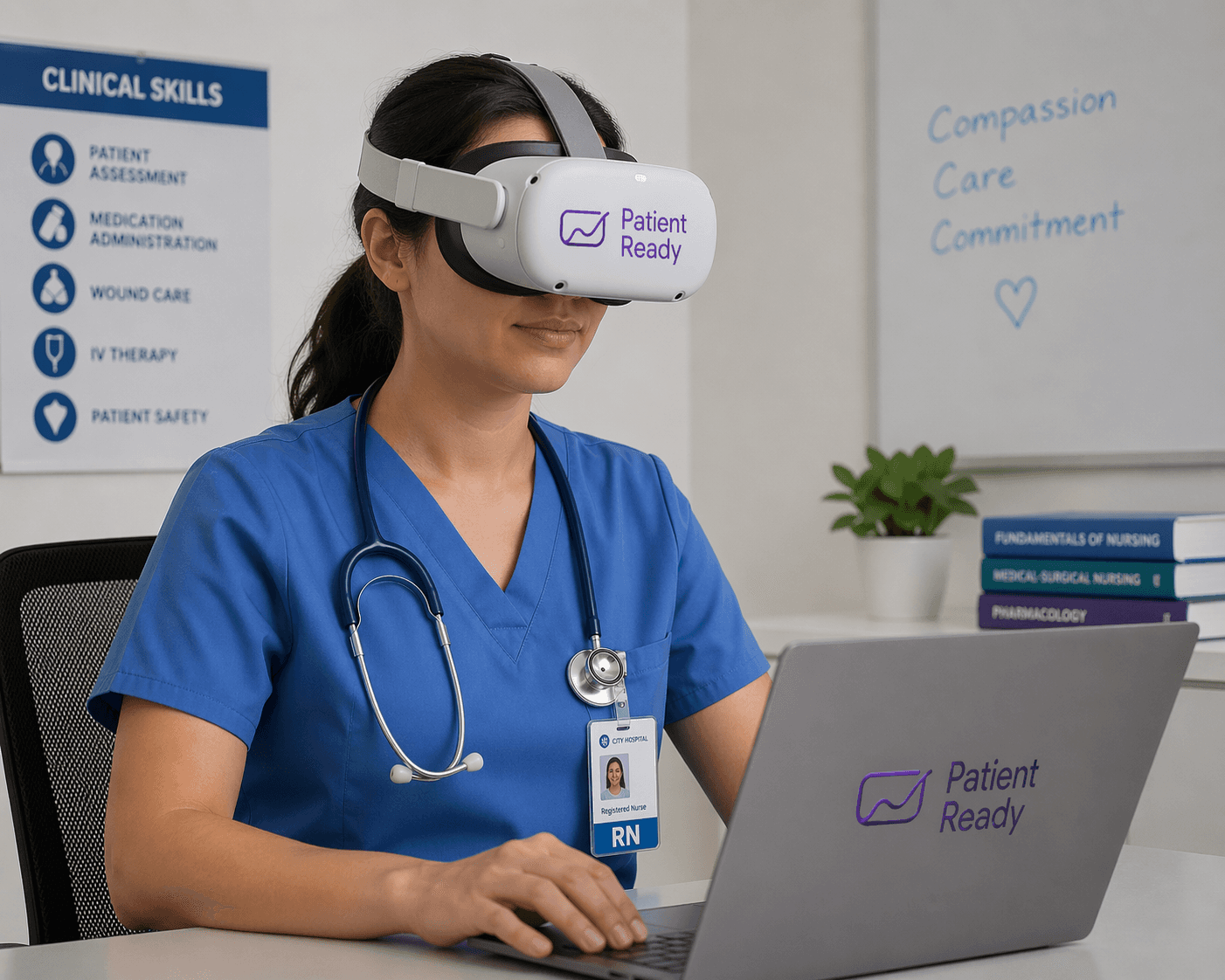
From Rare Events to Reliable Performance: How AI + VR Build Clinician Readiness for High-Risk, Low-Volume Events
How a multi-site North American health system used AI-enabled VR simulations to standardize training for low-frequency, high-acuity events, strengthen team response patterns, and reduce “first-time, live” risk without expanding simulation staff headcount.
Case Study Overview
Challenge & Context
High-risk, low-volume (HRLV) clinical events (often described as high-acuity, low-occurrence scenarios) create a readiness paradox: they happen infrequently, but require reliable performance when they do occur (AACN-CCN) (CHEST).
At the same time, traditional high-fidelity simulation can be resource intensive, with staffing, setup, and throughput constraints limiting how many high-quality practice cycles clinicians can complete (PMC-SIM) (INACSL).
Bottom line: Health systems need learning experiences that scale reliable performance for rare events without scaling educator and simulation labor at the same rate (PMC-SIM).
Approach & Solution Framework
A de-identified, multi-site health system partnered with Patient Ready to embed AI-enabled VR simulation inside annual competency and transition-to-practice pathways for HRLV readiness, designed to:
Increase repeatable practice for rare, high-stakes events using immersive VR scenarios that can be run more often than many traditional, room-dependent simulations
Standardize critical actions and escalation behaviors across sites and cohorts, reducing variability in exposure and expectations.
Strengthen debrief consistency using AI-supported learner artifacts (scenario summaries, decision-point highlights, teamwork/communication flags) to help facilitators focus faster on the moments that matter, while keeping human-led debrief central.
Operationalize responsible AI use with a governance-first approach emphasizing transparency, privacy protection, monitoring, and human oversight.
Measurable Results & Impact (Directional Outcomes)
Within early cycles, leaders reported directional (program-reported) outcomes consistent with published evidence on simulation and VR training for emergency skills and resuscitation contexts:
More HRLV reps per clinician for selected event types, enabled by repeatable VR modules and reduced dependency on complex physical setup.
Improved standardization across sites: more consistent exposure to the same escalation triggers and “critical actions” sequence.
More consistent baseline feedback: AI-supported artifacts helped reduce variability in first-pass formative coaching and sharpen debrief focus.
Fewer “first-time live” exposures reported for targeted rare-event workflows, aligning with the rationale for using simulation to prepare for high-acuity, low-occurrence situation.
Key Insights
Rare doesn’t mean optional. HRLV readiness is a reliability problem: systems must engineer enough practice cycles to make performance dependable.
VR standardizes exposure; AI standardizes baseline feedback. Together they support fairness, consistency, and scalability, especially across multi-site environments.
Governance builds adoption. Clear guardrails for responsible AI use protect trust and accelerate sustainable implementation.
1. Background & Context: Why HRLV Events Break Readiness
Clinicians rarely struggle in HRLV events because they “don’t know what to do.” More often, the gap is insufficient repetition under realistic cognitive load, which makes timing, sequencing, and teamwork behaviors less reliable when the real event occurs (CHEST).
Simulation-based training is widely used to build competence and improve performance in a safe environment, with structured design and debrief recognized as central to learning quality (PMC-SIM) (INACSL).
VR expands access to repeatable practice for emergency and resuscitation-related training, supporting more frequent exposure when traditional simulations are constrained by staffing, physical space, or setup complexity (ELSEVIER-VR) (PMC-CPR).
2. The Challenge: High Stakes Outcomes, Uneven Practice Exposure
The health system in this case study (de-identified) faced common HRLV readiness gaps:
Event rarity + cohort variability: some clinicians encountered specific crises in real practice; others did not.
Site-by-site training differences: annual competencies varied in depth and realism across locations.
Simulation throughput constraints: in-person high-fidelity events required significant staffing, reset, and scheduling coordination, limiting how many reps could be delivered per clinician.
Measurement gap: completions could be tracked, but performance patterns (late escalation, missed cues, communication breakdowns) were difficult to standardize and compare across sites.
Guiding question:
How can we deliver more standardized reps for rare, high-risk events (and measure readiness patterns) without scaling simulation labor at the same rate?
3. Objectives
Patient Ready and the health system aligned on objectives designed to be reusable for similar partners:
Increase HRLV practice reps per clinician for selected event types (individual + team response patterns)
Standardize critical actions (cue recognition, escalation triggers, role clarity, closed-loop communication)
Improve debrief consistency using structured, AI-supported artifacts, while keeping human facilitation central
Improve operational feasibility (throughput, scheduling flexibility, reduced room turnover for selected scenarios).
Establish measurable readiness signals (scenario performance trends, recurrent failure modes, remediation completion).
4. Approach: AI + VR as a “Reliability Layer” for Rare Events
4.1 Scenario Selection: Match Modality to HRLV Risk
The team prioritized scenarios where sequence, timing, and communication drive outcomes such as:
Rapid deterioration recognition (subtle cues → timely escalation)
High-stakes handoff under pressure
Pediatric critical airway crisis (rare but high consequence)
Sepsis escalation patterns
Anaphylaxis response
Massive hemorrhage / transfusion trigger recognition
This approach aligns with the rationale for using simulation to prepare clinicians for rare, high-acuity scenarios (CHEST) (AACN-CCN).
4.2 Technology & Learning Model
The deployment included:
Immersive VR scenarios to reproduce time pressure, interruptions, and environmental realism, consistent with VR’s use in emergency skills training and resuscitation education (ELSEVIER-VR) (PMC-CPR).
AI-supported learner artifacts (structured summaries, decision-point markers, communication/teamwork flags) to improve feedback consistency and reduce facilitator burden, without replacing educator judgment.
Repeatability by design: clinicians could re-run scenarios with targeted goals (e.g., earlier escalation, improved role assignment, cleaner closed-loop communication).
4.3 Debriefing Workflow (Best-Practice Aligned)
Each session followed a consistent structure:
Each session followed a consistent pattern aligned with simulation standards emphasizing intentional design and structured debrief:
Pre-brief (5-10 min): psychological safety, objectives, “what good looks like”
VR scenario (10-20 min): individual or team roles
Artifact review (3-5 min): key moments + gaps
Human-led debrief (10-20 min): meaning-making, transfer to unit workflows
Repeat plan: targeted re-run or assigned remediation scenario
5. Implementation: A Phased, Operationally Realistic Rollout
Phase 1: Pilot in One High-Volume Course
Focused on the highest-leverage rare events
Used existing competency language and rubrics where possible
Collected feedback from educators, preceptors, and participants
Phase 2: Operational Integration
Rolled out a shared HRLV “must-practice” set
Established scheduling and headset logistics that did not depend on full sim-lab staffing
Began basic analytics tracking (completions, repeat cycles, remediation completion)
Phase 3: Scale to Additional Courses
Integrated VR scenarios into transition-to-practice and annual competency rhythms
Used performance patterns to guide targeted coaching and follow-up practice
Expanded the library based on observed failure modes and local risk priorities
6. Results: More Reps, Clearer Patterns, Better Reliability Signals (Directional Outcomes)
6.1 Clinician Readiness: More “Practice Under Pressure”
Leaders reported that clinicians completed more repetitions of rare-event response patterns than was previously feasible with in-person-only simulation, consistent with VR’s use in emergency skills training and resuscitation contexts.
6.2 Standardization: Consistent Exposure Across Sites
Educators described greater consistency in what clinicians practiced and how “critical actions” were defined, reducing cross-site variability in HRLV readiness expectations.
6.3 Debrief Quality: Faster to the Moment That Matters
Facilitators reported spending less time reconstructing what happened and more time coaching why it happened, supported by standards-aligned debrief design.
Insight-to-Impact Bridge
Across healthcare, the readiness bottleneck is increasingly reps per clinician and coaching consistency per educator minute. When VR carries a share of repeatable HRLV exposure (and AI supports more standardized debrief inputs) systems can move from “we trained it” to “we can verify readiness patterns,” while keeping educators in control of interpretation and remediation.
7. Strategic Takeaways for Leaders
For CNOs, COOs, and Workforce Executives
Treat HRLV readiness as a reliability investment: rare-event performance improves when repetition is engineered, not hoped for.
Standardize “critical actions” across sites to reduce variability and improve confidence in readiness baselines.
For Simulation, Education, and Quality Leaders
Align VR delivery with simulation standards to protect learning quality at scale.
Use analytics to identify recurring failure modes (late escalation, role ambiguity, communication breakdowns) and target remediation.
For Residency / Transition-to-Practice Leaders
Reduce “first-time live” risk for rare events by sequencing HRLV practice earlier and repeating it, especially for new grads and float staff.
8. Future Directions
Building on early success, the program is exploring:
Expanded inter-professional HRLV scenarios (nursing + medicine + respiratory therapy)
Unit-specific variants (peds, ED, ICU, inpatient) with consistent critical actions
Stronger linkage between scenario patterns and individualized coaching plans
Ongoing governance updates for responsible AI use aligned to recognized principles
9. References
American Association of Critical-Care Nurses (AACN) / Critical Care Nurse. “Developing a Tool to Improve Critical Care Nurses’ Performance of High-Risk, Low-Volume (HRLV) Procedures.” Published Feb 1, 2026.
Source label: AACN-CCNCHEST Journal. “Preventing the Crash: Simulation-Based Training for High-Acuity, Low-Occurrence Events for Critical Care.” Published 2024.
Source label: CHESTElendu C, et al. PubMed Central (PMC). “The impact of simulation-based training in medical education.” Published 2024.
Source label: PMC-SIMAbbas JR, et al. Elsevier / Resuscitation Plus. “Virtual reality in simulation-based emergency skills training: a systematic review.” Published 2023.
Source label: ELSEVIER-VRTrevi R, et al. PubMed Central (PMC). “Virtual Reality for Cardiopulmonary Resuscitation.” Published 2024.
Source label: PMC-CPRInternational Nursing Association for Clinical Simulation and Learning (INACSL). “Healthcare Simulation Standards of Best Practice®.” Accessed 2026.
Source label: INACSLAssociation of American Medical Colleges (AAMC). “Responsible Use of AI in and for Medical Education: Key Principles.” Accessed 2026.
Source label: AAMCWorld Health Organization (WHO). “Ethics and governance of artificial intelligence for health: Guidance on large multi-modal models.” Published Mar 25, 2025. Source label: WHO