From Anxiety to Confidence
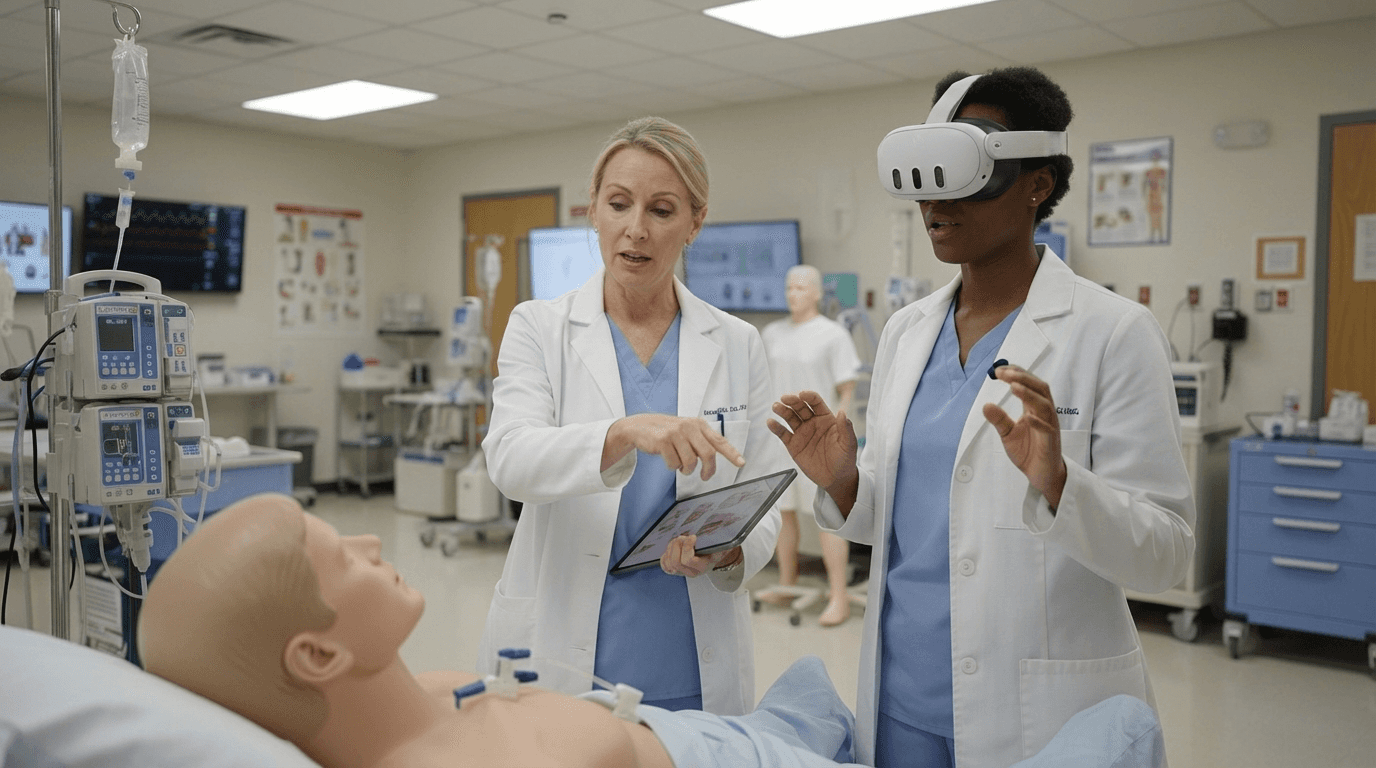
From Anxiety to Confidence: How AI + VR Help Nursing Students to Practice Difficult Patient Conversations
How a US-based nursing program used emotionally responsive VR and AI-powered virtual patients to scale communication training and reduce learner anxiety.
Case Study Overview
Challenge & Context
Pre-licensure nursing students consistently describe difficult patient and family conversations disclosing bad news, de-escalating anger, addressing errors, or exploring suicidal ideation as some of the most anxiety-inducing moments of their training.
At the same time, nursing programs and health systems face structural constraints: limited clinical placements, faculty capacity, standardized patient (SP) budgets, and lab time. In 2023 alone, U.S. nursing schools turned away 65,766 qualified applications to baccalaureate and graduate programs, largely due to shortages of faculty, clinical sites, and preceptors (AACN).
Simulation is an evidence-based way to close this gap, but traditional in-person simulations often serve only a small portion of students per session—and can trigger strong emotions like stress and anxiety that may overshadow learning (ScienceDirect).
Approach & Solution Framework
A regional, CCNE-accredited BSN program in North America partnered with Patient Ready to complement its existing simulation program with AI-powered, emotionally responsive VR simulations focused on difficult conversations.
The program’s framework:
Co-design of scenarios around priority conversation types (e.g., delivering serious news, disclosing errors, de-escalating distressed family members, responding to self-harm risk).
AI-driven virtual patients in immersive VR environments that adapt in real time to learner tone, words, and decisions, enabling unscripted dialogue and repeated practice (ajet.org.au).
Curriculum integration into existing communication, mental health, and capstone courses, aligned with AACN Essentials, Next-Gen NCLEX clinical judgment expectations, and structured frameworks like SPIKES for breaking bad news (CJON).
Analytics-enabled debriefing, using conversation transcripts and structured feedback reports to guide individualized coaching.Measurable Results & Impact (Directional Outcomes)
Within two terms, the program reported outcomes consistent with published evidence about simulation workload constraints and the effectiveness of VR learning:
Lower setup and troubleshooting burden for selected scenario types by shifting them into VR modules that require less physical room turnover than many traditional setups (directional; program-reported). This aligns with literature describing high-fidelity simulation as time-consuming to set up and difficult to staff (NIH).
More consistent baseline feedback via AI-supported summaries/transcripts, allowing faculty to spend more debrief time on higher-order coaching (clinical judgment patterns, communication nuance) rather than repeating foundational reminders (NIH).
Expanded access to high-quality reps (more learners completing more practice cycles) without proportionally increasing SP days or lab schedule complexity (directional; program-reported).
Improved learning indicators aligned to published research showing VR simulation can improve learning outcomes (including communication and knowledge measures) and may be cost-effective versus some traditional approaches (NIH).
Measurable Results & Impact (Directional Outcomes)
Within two terms of implementation, faculty and students reported outcomes consistent with emerging research on virtual simulation and AI-driven virtual patients:
Reduced performance anxiety: Learners described feeling less “frozen” and more prepared entering OSCEs and real patient encounters, mirroring evidence that simulation-based education can reduce anxiety before challenging communications (nursingsimulation.org).
Improved communication performance: Faculty observed more students meeting or exceeding expectations on existing communication rubrics (empathy, structure, clarity), in line with meta-analyses showing that virtual reality simulation significantly improves nursing communication skills (Frontiers).
Expanded access to practice: Every student in target courses completed multiple difficult-conversation scenarios, compared with prior reliance on a smaller number of SP days.
More consistent feedback: AI-generated, scenario-aligned feedback standardized the baseline level of formative coaching and freed faculty time for higher-value, reflective debriefs (Patient Ready).
Early signals of operational ROI: Program leaders reported the ability to support more learners in conversation practice without adding SP days or expanding lab space, echoing research that VR-based simulation can be more cost-effective than traditional simulation (PMC).
Key Insights
Anxiety is a solvable design problem, not a fixed trait. Thoughtful pre-briefing, emotionally responsive AI patients, and the ability to “try again” lowered psychological barriers to practicing tough conversations (ScienceDirect).
AI + VR unlocks scale for communication training. Instead of a handful of SP slots each term, an entire cohort can complete multiple unscripted conversations with standardized conditions and feedback (mededu.jmir.org).
Data transforms debriefing. Conversation transcripts, sentiment analysis, and structured feedback expose communication patterns that would otherwise be missed—including silence, avoidance, or over-talking (arXiv).
Patient Ready’s approach builds a bridge between education and practice. Scenarios aligned to health system realities (e.g., time pressure, family dynamics, cultural considerations) help deans and CNOs see a direct line from classroom practice to bedside impact (Winston-Salem State University).
1. Background & Context: Why Difficult Conversations Derail Confidence
Nursing students routinely rank difficult conversations—especially those involving conflict, mental health, or end-of-life decisions—as among the most stressful aspects of training. Qualitative research on emotions in simulation shows that unpleasant feelings like stress, tension, and anxiety frequently outweigh positive emotions during simulated patient encounters (ScienceDirect).
At the same time, evidence continues to mount that virtual and AI-enabled simulation is a powerful tool for communication training:
A 2024 systematic review and meta-analysis found that virtual reality simulation significantly improves nursing students’ communication skills with a moderate effect size (Frontiers).
Studies of virtual simulation tools designed specifically for difficult conversations report high acceptability and perceived usefulness among learners and faculty (PMC).
AI-driven virtual patient systems are emerging as scalable, adaptive alternatives to human standardized patients for communication practice (ajet.org.au).
Overlay these educational needs with the structural realities: nursing schools must produce more confident, practice-ready nurses, even as faculty, clinical placements, and SP budgets remain constrained. National data show tens of thousands of qualified applications turned away each year due to limited faculty and clinical sites—a direct bottleneck to workforce readiness (AACN).
In this context, Patient Ready’s AI-powered VR simulations become more than a technology upgrade—they are a strategic lever to transform how often and how safely learners can practice the hardest conversations they will ever have with patients and families (Patient Ready).
2. The Challenge: High-Stakes Conversations, Low Bandwidth for Practice
The nursing program in this case study (a regional public university in North America) had:
A strong foundation in traditional simulation (manikins, role-play, occasional SP encounters).
Faculty skilled in teaching communication, but limited SP availability and lab time.
Increasing numbers of students reporting high anxiety ahead of mental health, pediatrics, and community health rotations.
Through course evaluations and informal feedback, students shared that they:
Feared “saying the wrong thing” and making situations worse.
Avoided speaking up or taking the conversational lead when patients or families were upset.
Felt that one-off, highly scripted simulations did not fully prepare them for unscripted, emotionally charged real-world conversations.
Faculty, meanwhile, struggled with:
Capacity constraints: Limited SP budget and staff time meant most students only experienced one or two structured difficult conversations during their entire pre-licensure program.
Variability in feedback: Different faculty and SPs emphasized different aspects of communication, making it hard to benchmark progress across cohorts.
Emotional safety: Some learners left high-intensity simulations feeling overwhelmed rather than prepared, undermining confidence rather than building it (UKnowledge).
Guiding question:
How can we give every student multiple, psychologically safe reps in difficult conversations without adding more faculty, SPs, or bricks-and-mortar lab space?
3. Objectives
Together, the program and Patient Ready defined shared objectives that can be reused as a template for similar implementations:
Reduce learner anxiety before and during simulated difficult conversations, while maintaining appropriate emotional realism.
Improve observable communication performance on existing rubrics (empathy, structure, clarity, patient-centeredness).
Expand equitable access so that every student in target courses completes multiple, unscripted difficult-conversation scenarios.
Standardize formative feedback using AI-generated analytics and structured debrief guides.
Demonstrate operational value by relieving pressure on SP budgets, scheduling, and physical lab capacity over time.
4. Approach: AI-Powered VR for Difficult Patient Conversations
4.1 Scenario Design: From Theory to VR Conversation
Interdisciplinary faculty and Patient Ready’s learning designers co-created a set of conversation archetypes, each mapped to course outcomes and professional communication frameworks:
Delivering serious news (e.g., a new cancer diagnosis; disease progression) using SPIKES as an organizing structure (CJON).
Disclosing a medication or communication error and repairing trust.
Responding to suicidal ideation or self-harm risk in mental health settings (PMC).
De-escalating an angry or mistrustful family member at the bedside or in a tele-health visit (UKnowledge).
Navigating cultural or language-related misunderstandings, including micro-aggressions and bias.
Each scenario defined:
The patient/family profile (age, background, emotional state, social context).
Trigger events that would elevate the emotional stakes (new lab result, visible error, unexpected outcome).
Expected communication behaviors, aligned with existing rubrics and AACN Essentials (e.g., exploring patient perspective, summarizing, shared decision making) (Patient Ready).
4.2 Technology & Learning Model
Using Patient Ready’s platform, the program deployed:
Immersive VR environments that mirror inpatient rooms, outpatient clinics, or home visits.
AI-powered virtual patients and family members capable of free-text or voice conversation, responding with natural language and emotional nuance to what learners say and how they say it (ajet.org.au).
Emotionally responsive behavior models that escalate or de-escalate based on learner communication quality (e.g., validation vs. dismissiveness).
Automated formative feedback, summarizing what the learner did well and what could be improved (e.g., missed opportunities to explore feelings, jumped too quickly to solutions) (arXiv).
Learners accessed simulations via VR headsets in campus labs and, when possible, via non-immersive 2D mode on laptops—supporting flexibility and asynchronous practice (Patient Ready).
4.3 Curriculum Integration
Rather than adding a separate “tech pilot,” the team embedded Patient Ready scenarios into existing course structures:
Foundational communication courses: Early exposure focused on building comfort initiating conversations, using basic empathy and listening skills.
Mental health and pediatrics courses: Scenarios introduced higher emotional stakes and complex family dynamics (Hospital News).
Pre-licensure capstone and transition-to-practice courses: Advanced scenarios emphasized clinical judgment, inter-professional communication, and advocating for patient safety (PMC).
Each session followed a consistent pattern (reusable as a template):
Prebrief (5–10 minutes): Psychological safety, scenario framing, and review of relevant communication frameworks.
VR/AI Conversation (10–20 minutes): One learner leads the conversation, others observe or rotate through turns depending on course design.
Immediate AI feedback (3–5 minutes): Learners review automated feedback summaries and key moments flagged from the transcript.
Faculty-led debrief (10–20 minutes): Discussion of communication strategies, emotions, and transfer to real-world settings.
5. Implementation: A Phased, Low-Friction Rollout
Phase 1: Pilot in a Foundational Course
The program began with a single foundational communication course. Faculty selected one high-impact scenario and integrated it into an existing simulation week, replacing a lower-yield role-play activity rather than adding hours to the schedule.
Key implementation practices:
Limit the first cycle to one or two scenarios to avoid overwhelming faculty.
Use existing rubrics to evaluate communication; do not introduce new assessment burdens in the pilot stage.
Gather structured feedback from both learners and faculty after the first few sessions and make quick adjustments (e.g., timing, headset logistics, debrief prompts).
Phase 2: Expansion to Mental Health and Pediatric Nursing
Once the initial pilot proved feasible and acceptable, the team expanded scenarios into mental health and pediatric courses, emphasizing:
Managing suicidal ideation, self-harm risk, and family distress (PMC).
Practicing age-appropriate communication with adolescents and their caregivers.
Faculty noticed that students who had already used VR and AI patients earlier in the curriculum adapted quickly to more complex scenarios, requiring less time to orient to the technology and more time for substantive debrief.
Phase 3: Bridging to Health System Onboarding
In collaboration with a local health system, the school then adapted selected scenarios for use in new graduate nurse residency and onboarding programs, aligning Patient Ready simulations used in school with those deployed in practice settings (Patient Ready).
This alignment allowed:
A shared language around difficult conversations between academic and practice partners.
Early opportunities to map VR scenario performance to time-to-readiness and support needs in the first year of practice (e.g., extra coaching for communication, referrals to resilience resources).
6. Results: From Avoidance to Proactive Communication
6.1 Learner Experience and Confidence
Across reflections, course evaluations, and informal focus groups, recurring themes emerged:
Students described VR/AI scenarios as “safer places to fail,” reporting that it felt less intimidating to make mistakes with a virtual patient than with a human SP or real patient (PMC).
Learners reported greater willingness to initiate conversations, rather than waiting for faculty prompts or staying silent during conflict.
Many noted that repeated exposure to emotionally charged scenarios helped them normalize the discomfort and stay present with patients instead of shutting down.
These qualitative shifts mirror the broader evidence that simulation-based and virtual education improves communication self-efficacy and reduces anxiety before challenging patient interactions (Frontiers)
6.2 Observable Communication Performance
Faculty using existing rubrics and OSCE checklists observed that students engaging with Patient Ready scenarios:
More consistently established rapport and empathy early in the conversation.
Used structured approaches (such as SPIKES) rather than jumping straight into task-focused details (CJON).
Demonstrated improved summarizing and checking for understanding before closing the interaction.
While the program is still building formal pre/post datasets, early rubric trends and examiner feedback suggest that integration of AI-powered VR aligns with the moderate but significant improvements in communication performance documented in the literature (Frontiers).
6.3 Operational & Faculty Impact
Faculty reported spending less time on repetitive role-plays and more time on advanced debriefing, pattern recognition, and coaching (nursing.buffalo.edu).
Simulation staff noted that VR sessions required less physical setup and reset time than some traditional scenarios, echoing research that virtual simulations can be more efficient and cost-effective than high-fidelity mannequin-based simulation (PMC).
The school was able to offer multiple conversation reps per student per course, without adding SP days or expanding lab space.
Insight-to-Impact Bridge
These results are not isolated. Meta-analyses of VR and virtual simulation show consistent gains in knowledge, communication skills, and learner satisfaction—often with more active participation and better scalability than traditional simulation (PMC).
By pairing this body of evidence with Patient Ready’s emotionally responsive, AI-powered platform, nursing programs and health systems can translate individual learner gains into program-level readiness improvements: more students ready for complex communication demands and fewer surprises when they meet real patients and families.
7. Strategic Takeaways for Leaders
For Deans, Program Directors, and Academic Leadership
Mitigate the placement bottleneck: VR and AI simulations provide high-fidelity communication practice without additional clinical slots or SP budgets (AACN).
Differentiate the program: Embedding emotionally responsive VR conversations signals to prospective students and accreditation bodies that the school is investing in future-ready education (Winston-Salem State University).
For CNOs and Health System Leaders
Accelerate time-to-readiness: New grads arrive having already practiced difficult conversations that commonly challenge early-career nurses—before they impact patient experience or safety (LWW Journals).
Support retention and wellbeing: Creating repeated, psychologically safe practice with conflict, grief, and distress can reduce the shock of early clinical encounters and support resilience (ScienceDirect)
For Simulation and Faculty Leaders
Standardize quality: AI-enabled feedback and consistent virtual scenarios help align expectations across faculty and cohorts.
Free up human expertise: With baseline feedback automated, faculty can focus on higher-order coaching and nuanced debriefing rather than repeating basic communication reminders.
Insight-to-Impact
Across all roles, the pattern is clear: AI-powered VR does not replace faculty or SPs, it amplifies them.
Patient Ready’s approach layers scalable, data-rich practice on top of existing strengths, enabling organizations to:
Grow enrollment or residency cohorts without proportionally increasing simulation labor.
Focus faculty time where it matters most; on meaning-making, reflection, and advanced judgment.
Use real data on communication behaviors to inform quality improvement and workforce planning.
8. Future Directions
Building on early success, the program is exploring:
Inter-professional scenarios, bringing nursing, medicine, social work, and pharmacy learners together in shared virtual cases (arXiv).
Telehealth-specific conversations, including video and phone-based simulations that mirror real workflows (European Society of Medicine).
Advanced analytics, such as tracking patterns in empathy statements, open-ended questions, and interruptions to better understand cohort strengths and gaps over time.
These directions align with the broader shift toward AI-enhanced immersive simulations that support both individual learning and system-level insight into communication competence (arXiv).
9. References
Cho MK, et al. “The effect of virtual reality simulation on nursing students’ communication skills: A systematic review and meta-analysis.” Frontiers in Psychiatry, 2024. (Frontiers)
Fernández-Alcántara M, et al. “Virtual simulation tools for communication skills training in difficult conversations.” JMIR Medical Education, 2025. (PMC)
Skvortsova A, et al. “Acceptability of virtual reality for training health professions students in difficult conversations.” BMC Medical Education, 2025. (PMC)
Salo V, et al. “Emotions in nursing students’ simulations: A qualitative study.” Clinical Simulation in Nursing, 2025. (ScienceDirect)
Kiegaldie D, et al. “Virtual reality simulation for nursing education: Cost effectiveness and learning outcomes.” BMC Nursing, 2023. (PMC)
Padilha JM, et al. “Clinical virtual simulation in nursing education: Randomized controlled trial.” Journal of Medical Internet Research, 2019. (JMIR Publications)
Bowers P, et al. “Artificial intelligence-driven virtual patients for communication skills training: A scoping review.” Australasian Journal of Educational Technology, 2024. (ajet.org.au)
Lee K, et al. “Adaptive-VP: A framework for LLM-based virtual patients that adapts to trainees’ dialogue to facilitate nurse communication training.” arXiv preprint, 2025. (arXiv)
American Association of Colleges of Nursing. “Nursing Shortage Fact Sheet,” 2024–2025. (AACN)
Patient Ready website and blog content on AI-powered VR nursing simulations. (Patient Ready)
Queens University of Charlotte. “Nursing Students Prepare for the Real World with Cutting-Edge VR Technology,” 2025. (Queens University of Charlotte)
Kaplan M. “SPIKES: A Framework for Breaking Bad News to Patients With Cancer.” Clinical Journal of Oncology Nursing, 2010. (CJON)