Maximizing Quality and Patient Experience With VR and AI
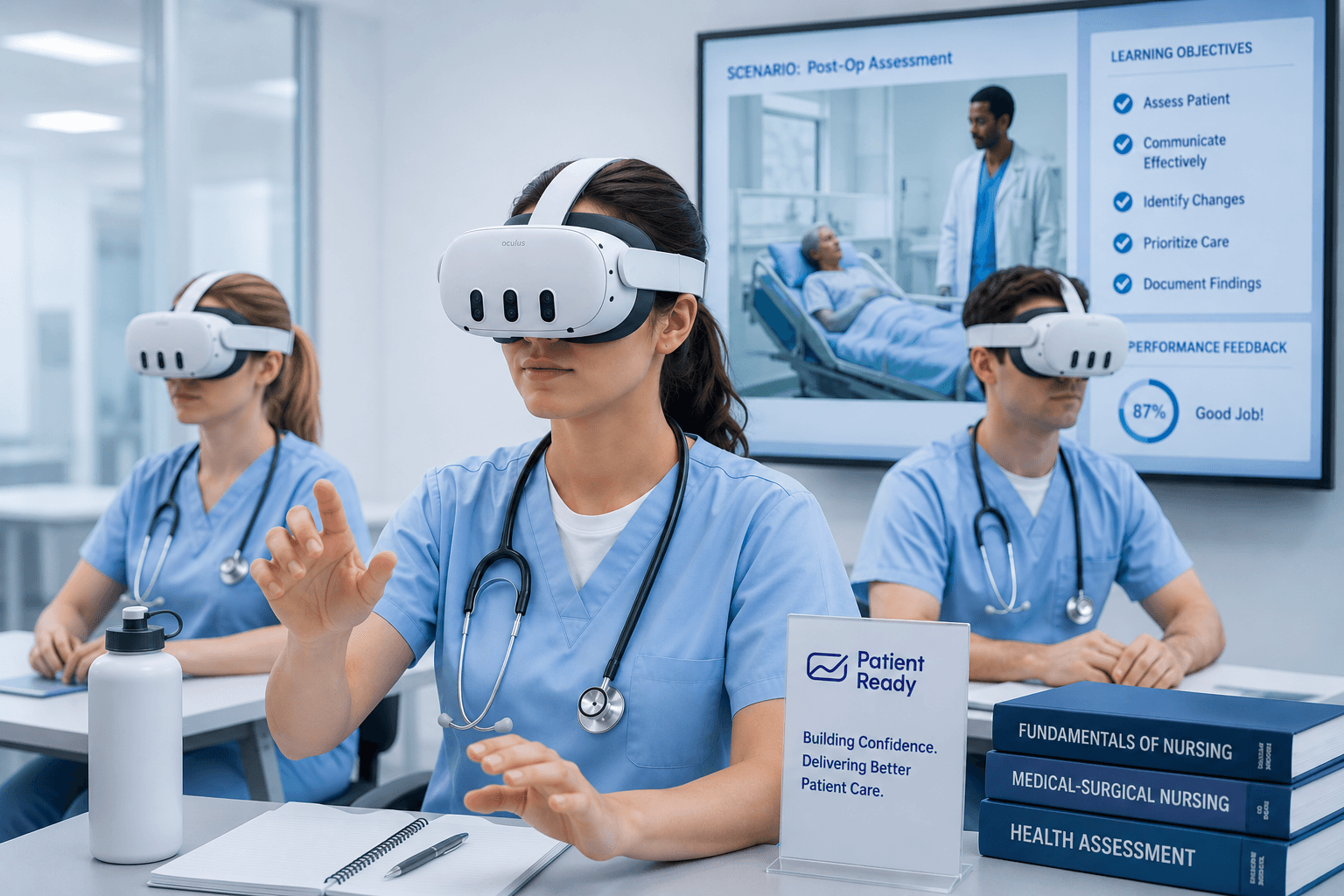
Maximizing Quality and Patient Experience with VR and AI
How immersive simulation and AI-driven communication training can improve care delivery, clinician confidence, and patient satisfaction.
Case Study Overview
Challenge & Context
Patient experience is shaped by repeatable behaviors that happen in hundreds of small moments, especially communication, responsiveness, and care coordination. These same moments are also tied to safety and quality processes such as escalation, bedside education, and discharge readiness (AHRQ). The system wanted to improve experience and quality without relying on one-time training events or inconsistent coaching.
The HCAHPS survey emphasizes critical experience domains including communication with nurses and doctors, responsiveness, communication about medicines, discharge information, care coordination, and overall rating (CMS).
Approach and Solution Framework
Patient Ready supported a VR and AI enabled readiness model designed to:
Standardize practice for high-impact patient interactions and high-risk care workflows
Make feedback more consistent across units through structured coaching and AI supported performance signals
Create a repeatable reinforcement loop that leaders could sustain across orientation, residency, and ongoing competency
Measurable Results and Impact
Partner reported program indicators included:
Improved consistency in communication behaviors during simulated and real workflows (for example: bedside introductions, teach-back, escalation scripts)
Faster identification of skills gaps with targeted remediation plans
Higher training completion and coaching follow-through compared with prior classroom-only refreshers
Stronger unit-level adoption of structured debriefing and reflective practices aligned to simulation standards
Key Insights
Experience and quality move together when training focuses on the behaviors that drive both, such as listening, explaining clearly, and closing the loop on questions.
VR works best when it is not a standalone module. It should be paired with coached reflection and role-based practice pathways.
AI is most useful when it reduces variation in feedback and supports leaders with simple, interpretable signals they can act on.
CTA: Learn how Patient Ready can strengthen quality and patient experience by standardizing practice and feedback across your workforce. Visit www.getpatientready.com to learn more.
1. The Challenge
Leaders identified three recurring issues:
Variation in how staff communicated during high-stress moments
Inconsistent coaching across shifts and units
Limited time for practice, feedback, and reinforcement in real clinical settings
Guiding question: How do we make experience-critical behaviors easier to do consistently, especially when teams are busy and conditions are unpredictable?
Why it mattered: Patient experience is not only a “soft” metric. Evidence shows patient experience is associated with important processes and outcomes, with communication as a core driver (AHRQ).
2. Goals and Success Criteria
The system set success criteria that balanced experience and quality:
Experience goals
Improve reliability of communication behaviors that map to HCAHPS domains
Strengthen patient understanding through clearer explanations and teach-back
Quality goals
Reduce avoidable variation in escalation, handoffs, and medication education
Improve team performance in scenarios tied to safety events and complaints
Operational goals
Improve training throughput without increasing educator burden
Create a scalable coaching model that works across units and shifts
3. Approach and Solution Framework
3.1 VR scenarios designed for experience and quality together
The VR curriculum prioritized moments that strongly influence both experience and quality, such as:
Responding to call lights and urgent needs with empathy and clarity
Explaining medications and side effects using plain language
Managing difficult conversations and de-escalation
Discharge readiness conversations using teach-back
Early deterioration recognition and escalation with a consistent script
3.2 AI supported feedback for consistency
The model used AI supported performance signals to:
Highlight missed steps and communication gaps
Support individualized practice plans
Improve inter-rater consistency by giving educators a shared starting point for feedback
3.3 Coaching and debriefing as the multiplier
VR practice was paired with structured reflection and coaching aligned to simulation best practice, including planned debriefing processes.
4. Implementation
The program followed a four-phase rollout.
Phase 1: Baseline and alignment
Selected priority experience and quality drivers
Defined observable behaviors and “what good looks like”
Aligned scenario outcomes with leader dashboards and unit priorities
Phase 2: Pilot on priority units
Piloted with a mix of new hires and experienced staff
Established a coaching cadence and manager reinforcement plan
Phase 3: Scale and embed
Integrated VR and coaching into onboarding and ongoing competency pathways
Used cohort reporting to identify common gaps and adjust scenarios
Phase 4: Sustainment and optimization
Continued updates based on patient feedback themes and quality event patterns
Built internal champions to maintain coaching quality over time
5. Results and Program Impact Signals
Partner reported outcomes were tracked across learning, adoption, and operational indicators.
5.1 Learning and readiness indicators
Examples of indicators used:
Scenario completion rates by role and unit
Percent of learners meeting competency thresholds after remediation
Time from first attempt to competence for targeted behaviors
5.2 Coaching and adoption indicators
Examples of indicators used:
Debrief completion rate and coaching follow-through
Unit leader participation in reinforcement activities
Cross-unit consistency in feedback quality
5.3 Patient experience and quality indicators
Examples of indicators used:
Trends in HCAHPS domains related to communication and discharge information
Trends in patient complaints related to communication breakdowns
Trends in quality event types where communication and escalation are contributing factors
Insight-to-impact bridge: The systems that see durable movement in patient experience typically treat it as operational reliability, not as scripting. By combining repeatable VR practice with structured reflection and leader reinforcement, teams build habits that hold up under pressure. That is where patient experience and safety improvements start to compound.
6. What Made This Work
Three design choices improved durability:
Behavioral specificity
The program focused on a small set of observable behaviors that leaders could coach consistently.Reinforcement built into operations
Practice was connected to unit routines, leader rounding themes, and competency expectations.Structured reflection
Debriefing was treated as essential, not optional, and aligned to simulation standards.
7. Strategic Takeaways for Leaders
For quality and patient experience leaders
Use patient feedback themes to choose scenarios that matter most
Translate complaints into observable behaviors that can be practiced
For CNOs and nursing leadership
Standardize escalation and communication behaviors across units
Invest in coaching consistency, not just content delivery
For education and simulation teams
Treat scenario design and debriefing quality as the highest leverage work
Use performance signals to focus educator time on the learners who need it most
8. Future Directions
Planned expansions commonly include:
Role-specific pathways for CNAs, nurses, charge nurses, and interdisciplinary teams
Specialty scenario bundles for ED, perioperative, ICU, and med-surg
Stronger integration with safety culture initiatives and manager coaching routines
If you are working to improve quality and patient experience through consistent practice and feedback, Patient Ready can help you design and scale a VR and AI enabled readiness model. Visit www.getpatientready.com to request a meeting.
References
(AHRQ) Agency for Healthcare Research and Quality. “What Is Patient Experience?”
AHRQ Patient Experience Resource(CMS) Centers for Medicare & Medicaid Services. “HCAHPS: Patients’ Perspectives of Care Survey.” November 24, 2025.
CMS HCAHPS Overview(INACSL) International Nursing Association for Clinical Simulation and Learning. “Healthcare Simulation Standards of Best Practice.” 2021 standards overview and related publications.
INACSL Standards of Best Practice